
A Boy Named Virgil, Part 13: Grammar School
Tales from a Small Village in Southern Illinois Circa 1900

A Boy Named Virgil is the first-person account of Virgil Bravard Browne, based on a letter he wrote to his niece, Marcia Moore Sagebiel, in 1958. The story is edited and read by me, his grandnephew. Read the introduction.
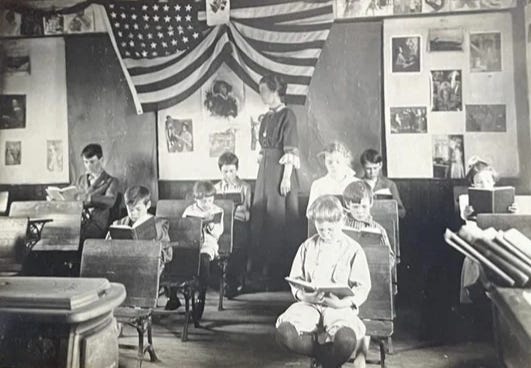
The schooling I was exposed to — namely, the eight grades of grammar school — was received in a red brick building.
It had five rooms, two hallways and a room that was used for both the principal’s office and library, which shelved possibly 200 books on various subjects, mostly nonfiction covering history, travel and other topics fitting for pupils in grades one through eight.
‘I Read Everything’
There were a few works of fiction, among which I recall Little Women and the companion book Little Men by Louisa May Alcott, Under Two Flags and With Lee in Virginia by Henty, I believe. I had an appetite for reading that could not be satiated by the limited supply of literature available to me so I read everything I could lay my hands on, no matter the subject.
I came to know a local lady who had a personal library that exceeded the school library in size and variety. She kindly allowed me to borrow books from her, which was a great favor since most of the books were handsomely bound, some even in tooled leather.
I recall a few of the titles.

One that greatly impressed me was Les Miserables by Victor Hugo, a tale of the French Revolution.
There were several books by Jack London: Martin Eden, The Sea Wolf, Tales of the Sea and a story about a dog that was kidnapped as a puppy and taken to Alaska, where he became a famous sled dog.
I still recall, in part, a little poem that the lead character in Martin Eden quoted in delirium. He was down on his luck in every way. In my opinion, it was a thing of beauty. I will give you what I can remember:
I am done, put by the lute. Once I sang as other thrushes, trilling in the dewy bushes. Now I’m done, put by the lute. I am like a weary linnet, and my throat has no song in it. I am done, put by the lute.
It has been at least 50 years since I last read this, but it stayed in my memory as if it was yesterday.
School Subjects
In school we were taught the three “R’s” thoroughly since they were considered to be the essential things. For if one could read, write and have a good comprehension of arithmetic, the rest of the subjects would come with little trouble.
We also had physiology, spelling, language (later called grammar), American history and orthography. The latter two we did not have until we were in the fourth grade.
I disliked grammar most of all, and, secondly, arithmetic. (I had no difficulty with the subjects I could memorize.) I did not do well with arithmetic until I entered the sixth grade when, for some reason, I seemed to understand it and began getting good grades. I forgot to mention the subject of geography, in which I did well.
I considered grammar to be beyond my ken1 and still do, although I excelled in composition. The essays I wrote received very good grades. I couldn’t parse a verb but could tell a story.
A Mad Dash
The school building was located on the southern edge of town and bordered to the west and south by a farmer’s field and to the east by my mother’s garden. A road ran along the northern side of the school.
The street heading north toward town was known to a few as Noble Avenue. Four blocks north it crossed Main Street and three blocks farther it left town.
Grandpa’s house was across from the Baptist church and a short block from school. If there was a chore I needed to do at noon or early in the morning, I was not allowed to leave home until the five-minute bell had rung. I’d make a mad dash for school, reaching the school grounds in about one minute.
After dismissal time, which was four o’clock, I was expected to be home within five minutes. Woe to me if I was kept in after school for a half hour, which did occur at times. The cause of my delay took a lot of explaining once I finally reached home.
There was no staying at the school grounds to play “choose up” ball, “leapfrog,” or “shinny,” which was a hockey game of sorts played with sticks and a block of wood or a tin can.
This game was a modified form of mayhem since shin cracking was legal if you failed to give ground when a member of the rival team was in pursuit of the block or can. There also was the ever-present danger of the block going airborne and hitting you in the face.
I don’t recall that anyone was ever seriously injured, although we were, at best, a poor risk for an accident policy.
Graduation Day
After eight long years of attending school, at last came the day of graduation. I took an examination given by the county superintendent of schools and passed with an average of 94, first in a class of 32 students.
I was properly edified, of course, especially because I ranked higher than a girl named Mary Palmer, who had ranked first the entire year and had sorely needled me about my dallying in second and third place.
My deportment was a great drawback. I seldom got a grade of more than 70 in it, while Mary, who was a model of decorum, got at least 95. But in the county examination there was no grading on deportment, and that allowed me to surpass her.
With the cruelty of children, as soon as I had the opportunity I gave back to Mary the needling she had made me suffer. To my consternation, she burst into tears, causing me to beat a hasty retreat feeling very much like a heel and confused about this reaction from a girl.
Even to this day the workings of a woman’s mind are still somewhat of a mystery to me.
This is the concluding part of the boyhood tales of my great uncle. An epilogue will follow.
Thank you for reading. If you liked this slice of FRIED BOLOGNA, please click the 🤍 and leave a comment. Access the archives.
A word from Old English that means beyond what someone knows or understands (Britannica).
This has been such a wonderful series! I look forward to the epilogue!
This peek into a turn of the century schoolhouse was very interesting. I was surprised by the study of physiology. Wondering if it wasn't what we later called "health" class? Also that spelling was succeeded by the study of orthography.
I am so disappointed we have come to the end of Virgil's memoir.